European Political Unification
Europe is an interesting place because right now because the countries of the European Union are standing at a critical juncture. Currently many of the member states of the European Union share a currency, the Euro, and thus have a unified monetary policy. From the introduction of the Euro in 1999 until about 2008, this system worked fine. However, when the world ran into financial meltdown in 2008, the Eurozone also began to suffer.
This is a current map of the Eurozone.
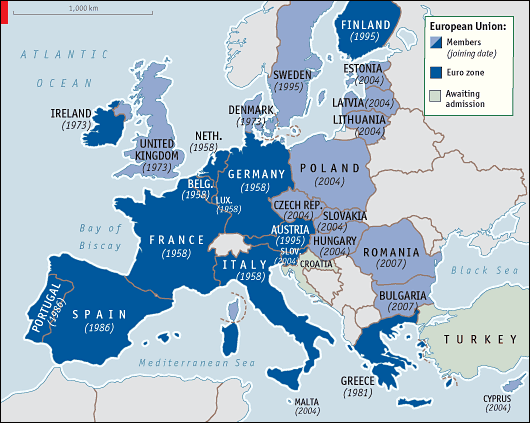
Many countries in the southern portion of the Eurozone such as Greece, Italy and Spain used the financial health of the northern Eurozone countries of Germany and France to borrow money that they could not afford to repay. When the financial crisis hit, the actions of Greece, Italy and Spain not only affected themselves, but also affected the countries in the northern Eurozone who had been responsible with money.
This system is extremely fragile and is unfair to countries like Germany. Europe needs to at the very least adopt a fiscal policy for the Eurozone. This would mean that a centralized Eurozone bank would make financial decisions that all Eurozone countries would need to follow. This would leave Europe in a state of fiscal union but not political union. For Europe to show itself as a true world economic power, I believe that it must also take steps towards a political unification.
If Europe decides to make joint monetary decisions, but does not stand on the same page politically, there could be many conflicts of interest. It would be a good step for Europe if it decides to unify financial policy, but any developments in this area would be unstable without political cooperation. Europe has already taken steps towards acting as a single unit with the Euro, but they can make more progress if they take the next step towards a political union.
If the Eurozone is unified as one political body, it would assert the strength and value of the Euro. This could increase trust from other countries and help to stabilize financial markets in Europe. For the past six years Europe has been in economic turmoil and it is time to take dramatic steps to help pull the continent out of depression. I believe that a politically unified Europe, while challenging to develop, could only help the economic situation in Europe.
Labels: demographics, Euro, Europe, European political union, european politics, European Union, Eurozone, eurozone fiscal policy, political change, politics, urban development
posted by Unknown @ 10:30 AM
0 Comments


