Monday, November 25, 2013

The Paradox of Language: America v. Europe

English at Home and Abroad

I want to start off by saying that I have a deep respect for languages. I have a strong interest in learning as many as possible and about learning about the cultures that correspond with language. I am a strong supporter of having a multilingual population. But despite my fascination with language, I have to admit that we have a problem, both here in the United States and across the pond in Europe. In America we do not have enough respect for our language, but in Europe language is so strongly bound culturally that if you travel far from your home, few people are likely to be able to understand you.

America: i luv u see u @ home tmrw


American English has really deteriorated over time. I find that in general, Americans do not like to write or speak in complete sentences and often say things that do not make sense. Some of my favorites are "I seen it" "I axed him a question" or "I am going to watch there dog this week" But in all seriousness, we have to admit that as a society we do not place much respect on our language here. The blame for this probably lies somewhere between our lackluster public education system and social media, but rather than pointing fingers, I feel that we should look for a solution so that Americans can begin to speak properly again.

Europe: Ich kann das nicht verstehen! 

Europeans place such emphasis on speaking properly and for that, I think that Americans owe them a lot of respect. But at the same time, the wide variety of languages spoken across the continent can cause so much confusion for people. Even within countries there are often so many dialects of a single language that traveling 50 kilometers can cause a linguistic nightmare.


This map is completely overwhelming to me. It shows the various languages that are dominant in any given part of Europe. Notice again that the colors of language groups do not neatly fit within national borders. This can cause political and administrative nightmares for the people of Europe. Languages and dialects are so important to Europeans, but they are so specific that they cause problems. 

Now What? 

I think that America and Europe both have an opportunity to learn from one another. First I want to point out that in Europe, about 51% of the population are proficient with English. According to the New York Times, in America, only 20% of people can hold a conversation in a language other than English. I believe that these two numbers point towards a solution. 

In Europe we can say that most people are at least proficiently bilingual. My idea is to further expand English education throughout Europe alongside a country or regions native language. If almost all europeans could communicate in English as well as in their native language, europeans could communicate easily with one another regardless of where they reside. Rather than countries fighting internally and externally over official languages, if everyone learned English many of the problems would be solved. Take Spain for example. There is a huge battle being waged now between the blue of Spanish speaking Spain and the darker blue color on the East coast of Catalan speaking Spain. These two areas struggle to communicate and are battling over language, but if both regions could speak English, it would detoxify their current struggle.

In America most people cannot speak a foreign language because it is not strongly emphasized in school. If we are a society were forced to learn more about languages from a young age, we may place more value and respect on English. Not to mention the fact that having knowledge of more than one language helps to piece together grammar rules themselves. 

If America and Europe can learn a bit from one another the world could become a much less confusing place!


Labels: , , , , ,

Monday, July 15, 2013

Top 3 European Travel Destinations

Best European Cities for Tourists

I will start this post with a disclaimer, I have not actually travelled to any of these places. Yet. I am still in college and right now there is no way that I would be able to afford to travel as much as I would like! I'm sure that when I am older and actually can afford plane tickets to travel, my perception of my favorite places will change, but based on my own research and desires, here are a list of the 3 European destinations I would recommend visiting.

1. Monaco


I wanted to start with Monaco because it may be a destination that some may feel is a bit obscure. And it is. This picture actually captures the entire country, which is less than 500 acres. Monaco is a resort paradise located near the French city of Nice on the French Riviera. It has a mild climate year round and a unique mix of local, French and Italian cultures. Monaco is known for having great casinos and nightlife.

2. Copenhagen 


Copenhagen is a medium-sized city located along the Baltic sea. It is the capital of Denmark and known as being one of the happiest and most liberal cities in the world. Copenhagen is a city of bikes and friendly people. The city is also known for being environmentally friendly city. Despite all of these good things, I would recommend only visiting in the summer months as winters can be quite cold this far north. 

3. Prague


Until recently I never would have thought much of Prague, I simply lumped the Czech Republic in with Germany and Austria. However, one of my best friends is about to move there to teach English as a second language and so I took another look at the city. It is absolutely beautiful. Looking at photos, I cannot think of a more picturesque city. Prague is filled with medieval elements, stone bridges, castles and cobblestones. It also may be the first European city that I have the chance to visit this winter! 

Check Out my Other Travel Posts Here!
Planning a Cape Cod Vacation?
My Five Favorite New England Beaches
Cheapest Ways to Fly

Labels: , , , , , , , , , ,

Monday, June 17, 2013

Reasons to Travel to Europe

For most of my life I have wanted to travel to Europe. My desire stems from studying maps and learning about history as a kid. I remember being fascinated by Greek and Roman history and learning about many various european cultures. For most of my life this remained a dream, but this winter I may finally have a chance to spend a few weeks abroad. Here are some reasons you (and I) should spend some time exploring Europe.


It's Cheaper than you Think: Round trip flights to Europe from the United States can be found for less than $800 if you plan far enough in advance. I am looking for tickets from Boston to London for December, during the holidays, and tickets are still less than $900, (about the cost of 9 nice sweaters). Once you arrive in Europe, it becomes extremely cheap to stay. According to Hostels.com/europe, many cities have hostels with great reviews for $5 - $10 per night! If you can stay for more than a week, the expensive flight can quickly be offset by room expenses.

Gain a New Perspective: Often people spend most of their lives in one country or even one small region of a country, New England in my case. While the area you live in my be comfortable and pleasant, other areas can offer extremely different experiences. Most people become accustomed to their own culture and way of life and can gain so much from learning the customs of people who live differently. This sense of discovery can foster an appreciation for diversity as well as of one's own cultural identity.

Travelling in a foreign country is a way to challenge your own perspective on life and gain new ideas. If you stay in one place for your whole life, you may not develop a full sense of happiness because you have nothing to compare it to. While travelling you may discover that you want to relocate to a new place or you may develop a newfound love for your home country or city.

Gain a Sense of Independence: Having the opportunity to travel, especially to a country where you are unfamiliar with the language, provides a pathway to becoming more independent. Being somewhere totally new will force you to think in ways you may never have thought and use skills that you may not have used before. Interacting with locals and making your way through a foreign land without help can make you proud and feel capable of accomplishing more than you thought possible of yourself.

Carpe Diem: If you are thinking about travelling, whether it be to Europe or elsewhere in the world, my advice is just to do it. Life only comes once and if you have an opportunity to go somewhere you have always wanted to go, just do it. I realized recently that when I am much older and look back on my life, I want to know that I did all of the things that I always wanted to do and so I am trying to live by my own advice. Sure, it may be expensive, but there are ways to save money. People tend to enjoy experiences more than their material belongings. Besides, who needs all of those sweaters anyways?


Labels: , , , , , , , , , , ,

Sunday, June 9, 2013

European Political Unification

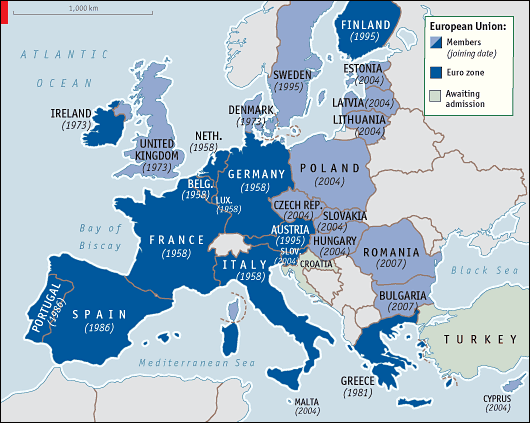
Europe is an interesting place because right now because the countries of the European Union are standing at a critical juncture. Currently many of the member states of the European Union share a currency, the Euro, and thus have a unified monetary policy. From the introduction of the Euro in 1999 until about 2008, this system worked fine. However, when the world ran into financial meltdown in 2008, the Eurozone also began to suffer.

This is a current map of the Eurozone.


Many countries in the southern portion of the Eurozone such as Greece, Italy and Spain used the financial health of the northern Eurozone countries of Germany and France to borrow money that they could not afford to repay. When the financial crisis hit, the actions of Greece, Italy and Spain not only affected themselves, but also affected the countries in the northern Eurozone who had been responsible with money.

This system is extremely fragile and is unfair to countries like Germany. Europe needs to at the very least adopt a fiscal policy for the Eurozone. This would mean that a centralized Eurozone bank would make financial decisions that all Eurozone countries would need to follow. This would leave Europe in a state of fiscal union but not political union. For Europe to show itself as a true world economic power, I believe that it must also take steps towards a political unification.

If Europe decides to make joint monetary decisions, but does not stand on the same page politically, there could be many conflicts of interest. It would be a good step for Europe if it decides to unify financial policy, but any developments in this area would be unstable without political cooperation. Europe has already taken steps towards acting as a single unit with the Euro, but they can make more progress if they take the next step towards a political union.

If the Eurozone is unified as one political body, it would assert the strength and value of the Euro. This could increase trust from other countries and help to stabilize financial markets in Europe. For the past six years Europe has been in economic turmoil and it is time to take dramatic steps to help pull the continent out of depression. I believe that a politically unified Europe, while challenging to develop, could only help the economic situation in Europe.

Labels: , , , , , , , , , ,